
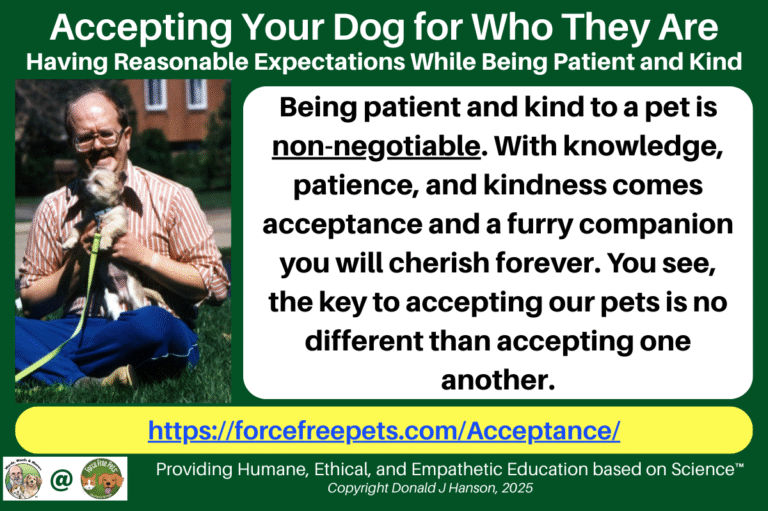
Accepting Your Dog for Who They Are
Having Reasonable Expectations While Being Patient and Kind
By Don Hanson, PCBC-A, BFRAP
< A version of this article was published in the OCT 2025 issue of Downeast Dog News>
< Updated 2025-10-01 >
< The link to this page – https://www.forcefreepets.com/acceptance/ >
Countless times, I have heard:
“I wish he were more like my old dog,”
“The breeder said this breed is always good with children, “
“She’s always getting into things,”
“The shelter said he wouldn’t run off,” or
“She’s certainly no Lassie.”
The people who say these things are not happy, and it’s likely their dogs are unhappy as well.
The “Lassie Myth” is a significant reason for their disappointment. When people compare their dog to a mythical ideal, they set themselves up for  disappointment. The books, movies, and TV shows featuring Lassie were all heart-wrenching but fictional stories.
How would you like to be compared to <insert legendary hero> throughout your life? Our desire that our dog should be the perfect Lassie, or exactly like our last dog, is not a reasonable expectation.
I’ve been there. Before I became a pet care professional, my wife and I brought a Cairn Terrier puppy named Gus into our family. We loved him dearly despite his many quirky medical and behavioral issues. Gus was a significant reason we became pet care professionals. When we did, my ego was solely responsible for expecting Gus to be something he was not: perfectly obedient with little to no undesirable behaviors.
New to the profession, I wanted to use Gus to “show off” my skills. As a result, we trained constantly. One day in class, we were practicing a recall. Gus started moving towards me the instant I said “Come,” but he was moving as slowly as possible. At the end of the class, the instructor took me aside and was blunt: “You are both miserable. Neither you nor Gus are having fun, so please, rather than training, go do something that’s fun for both of you.” That instructor, my friend Kate, saved the Gus/Don relationship. I had allowed training to take precedence over simple, joyful interactions with my furry companion. In other words, I was not a very good friend to Gus. Kate, thank you for kicking me out of class and helping me understand that training ALWAYS needs to be fun for both the dog and the person.
I have learned a great deal since then and have taken a very different approach with my dogs, ensuring that our relationship and having fun take precedence over training. I share that with my students, teaching them that a dog is a totally different species with their own physical, mental, and emotional needs, as well as corresponding normal and abnormal behaviors, and an entirely different way of expressing their emotions and communicating. Without  that knowledge, they cannot have realistic expectations, nor can they have a relationship with a dog that is as joyful to the dog as it is to them. In other words, what many call “Dog Obedience” classes would be better named “Learning to Live Joyfully with a Different Species” classes.
Unfortunately, far too many pet care professionals (trainers, veterinarians, breeders, shelter workers, authors, and more) still spend far too much time talking about teaching blind obedience and giving people unrealistic expectations for their dogs. When you want to sell a puppy or adopt a dog into a new home, it is often easier to make them look better than they are by glossing over any potential problems or embellishing positives. Statements like: “This breed is always good with kids,” “Yes, he’s completely housetrained and knows how to sit,” “Your dog will learn everything they need to know in seven weeks,” might make it easier to place a pet or to sell a service, but at what price to the dog?
Petcare professionals MUST ALWAYS be honest and transparent about the pets they are trying to entice you to purchase or adopt. We have a responsibility to explain that if you want a pet, you MUST educate yourself about the pet’s needs and then be committed to meeting them. It’s not as simple as buying the dog, a collar, a leash, some cancatoys, and food. Having a pet as a family member requires an investment of time, just like adding another human to your life. If you don’t have the time and energy to commit to that, don’t get a pet.
Original version published in Green Acres Kennel Shop Paw Prints, January 2005.

