The Wisdom of Rotating Your Pet’s Diet
By Kate Dutra & Don Hanson
< A version of this article was published in the AUG19 & SEP19 issue of Downeast Dog News>
< Updated 2025-05-11 >
< The link to this page – https://www.forcefreepets.com/RotatingWhatYouFeedYourPet/ >
Some Background from Don
Probably more than once, many of you have been told, “ALWAYS feed your pet the same thing.” The same thing is typically a bag of hard brown nuggets (kibble), often labeled “Recommended by Veterinarians.” This alleged food is shelf-stable for a year after being manufactured at intense pressures and temperatures that destroy much of the ingredients’ nutritional value. It is an ultra-processed product that is the exact opposite of fresh, whole food. It is equivalent to your doctor or your child’s doctor telling you to eat mac and cheese from a box with a side of corn or potato chips, for every meal, every day of your life. It is NOT optimal nutrition, nor is it common sense. In my opinion, the idea that we should only feed our pets the same highly processed food for their entire life is the most dangerous lie of many lies perpetuated by the pet food industry.
In the early 2000s, my team and I learned the importance of feeding fresh, whole food and rotating what we feed after reading The Truth About Pet Foods by veterinarian Dr. R. L. Wysong. Many of us started doing so and observed increased vitality in our pets. In May 2005, I asked Kate Dutra, our operations manager at the time, to write an article on the topic for our client newsletter. The article resulted in a great deal of positive feedback from many of our clients, who typically responded, “That makes perfect sense!” However, we also had some negative comments from a few veterinarians: “That’s not what they taught us in vet school.” One pet food company responded, “ That will ruin our sales!” because we also suggested rotating among brands.
We still believe strongly in the benefits of dietary rotation, and many veterinarians and pet food companies have since jumped on the bandwagon. In 2019, I asked Kate to update her article, and I am now updating it again in 2025.
Would You Be Healthy If You Ate the Same Thing at Every Meal?
Tokyo turnips dipped in cilantro hummus, a ham, cheese, and lettuce sandwich on organic seven-grain bread, raw pepper, tomatoes, and cucumbers, and a handful of pretzels comprised my lunch  today. Overall, most would agree that it was a healthy, well-balanced meal. What if I ate this same meal every day, twice a day, for several years? Is that still considered healthy and well-balanced? Probably not.
Why do we consider this acceptable for our canine and feline companions? Pet food companies, veterinarians, breeders, and others have convinced us that changing our pets’ food is difficult and will result in digestive upset. Intuitively, we understand our pets should have more variety in their diet; however, there is also a grain of truth to the tummy troubles. If your pet has been fed the same food for several months or longer, they may experience digestive upset, and possibly diarrhea, when their GI tracts are exposed to a different food.
Feeding the same thing repeatedly can harm your pet’s gut microbiome. The gut microbiome is the trillions of microorganisms that live in your pet’s GI tract. These microorganisms work in synergy with the body to help digest food and optimize ingested nutrients. However, some of these microorganisms also depend on a varied diet of fresh, natural food and die off when only fed highly processed junk food.
One of the incredible benefits of rotating your pet’s diet is that you can often feed a new food without a slow introductory process of switching food over many days. Because they have a robust gut microbiome, it’s not a challenge to your pet’s GI tract when they eat something new. Unfortunately, due to genetics, overuse of antibiotics, or other offenses to the gut microbiome, some pets may require you to change food slowly.
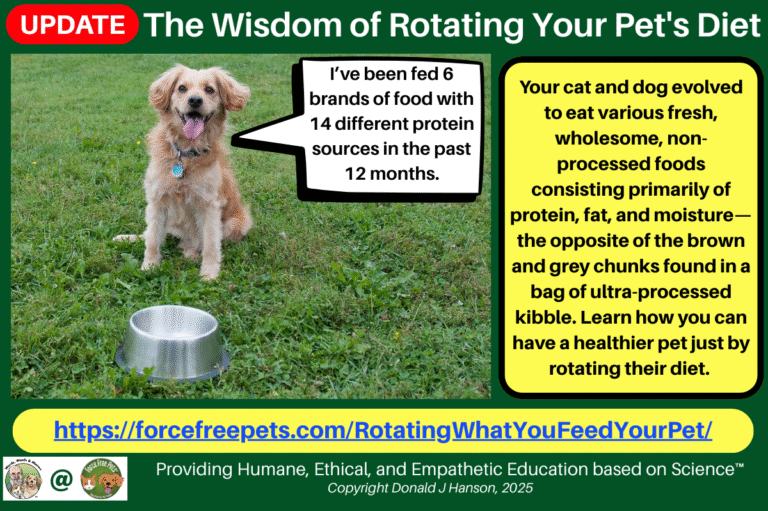
Sadly, many companies do not want us to change our pets’ food because it impacts their bottom line. Fortunately, several companies now offer their foods with various animal protein sources and have adjusted their diets to allow for a smooth transition from one type of food to another. While this is a good start, it is insufficient. Dietary rotation is not just limited to rotating within a food brand but also includes rotating among brands and food types.
Dietary rotation has many reasons. The most obvious is to increase our pets’ exposure to a variety of meat sources, thus giving them variation in both macronutrients and micronutrients. Whether it is kibble, canned, freeze-dried, or raw, varying the meals between red meats, poultry, fish, and some of the more novel protein sources can be a simple way to benefit our companions’ nutritional well-being.
By rotating brands, even when using the same meat protein, we are increasing the odds of slight diet variations. All chickens (turkey, pigs, etc.) are not created equal. For example, one company may source its chicken from a poultry farm in the Midwest and another from New York. Both farms may be certified organic, but the soil in the Midwest has nutrients different from those in New York. The air and water quality will also vary, and the farms may use dissimilar poultry feeds. This results in slight differences between the chickens, and as we learn more about nutrition, we discover that these differences matter.
Another rationale for brand rotation is the chemically synthesized vitamin and mineral packs that must be added to dry and canned pet foods. Because of the high heat and pressure used to make kibble and even canned pet foods, the natural vitamins in the food before it is cooked are typically destroyed during manufacturing. While all these supplemental packs should meet  industry standards, there will be some variation because many of these vitamin and mineral packs are proprietary blends manufactured for specific pet food companies.
We still do not understand everything about human nutrition, much less the nutritional needs of other species. Nutrition is a very complex science that shifts with evolution and the environment. The statement “100% Complete and Balanced” on some pet foods is not a fact but is at best a guess and is more a sign of the manufacturer’s arrogance than anything else.
Furthermore, recalls and shortages do happen. If your pet can only eat one food and that food is recalled or unavailable for some reason, you may find yourself floundering. If, however, you have introduced multiple foods and proteins to your pet, you will have other options available. It is also essential to have an alternative protein because when there is a shortage of a specific ingredient, it is likely to impact multiple pet food brands.
A final reason to add variety to our pets’ diets is boredom. There is a middle ground between creating a picky eater and offering variety. We control so much in our pets’ worlds and unintentionally deprive them of choices and experiences, which is an easy way to enrich their environment.
Introducing Your Pet to Dietary Rotation
Understandably, you may be hesitant to make this change based on past experiences where you changed your pet’s diet. I have been there personally, and the initial consequence of diet change for one of my dogs was ten days of bloody diarrhea and a miserable pup. Often, it only takes one bad experience to convince us that we should never try again. My argument stands, however, that we should not succumb to this fear; instead, we need to work slowly and methodically to strengthen our dog’s gut so that they can easily handle dietary change.
The first step in introducing dietary rotation is to consider your dog as a unique individual. Things to reflect upon are your dog’s age, health issues, and how long they have been consuming a specific diet. When dogs are young, it is usually easy to help their systems to handle a variety of diets by simply introducing an assortment of foods. Puppies are typically fed three to four times a day, and there is no reason that each meal cannot be different. It is a little more work and a bit more costly, but feeding a variety will have lifelong benefits.
For the older dogs that have been eating the same diet for months, if not years, moving at a slower pace will most likely be necessary. A good starting point is to determine if you want to use a different manufacturer or feed an alternate protein source from the same company. Many pet food companies have come to understand that people want variety for their animals and offer foods with multiple protein sources. To keep you as a loyal consumer, they have tried to make transitioning your pet within their product line as easy as possible. Their diets often contain common ingredients, identical vitamin and mineral packs, and similar probiotics and prebiotics. Usually, I recommend you start by changing the protein source to something new. Instead of feeding a chicken-based diet, choose one formulated with beef, salmon, turkey, anything but chicken.
On the other hand, if you are looking to switch manufacturers (remember, many manufacturers make several brands), it may be best to match the protein source to keep the ingredients somewhat similar. For example, if an animal has been eating a chicken product from Manufacturer A, start with a chicken-based product from Manufacturer B. The sourcing, nutrient availability, and formulation will be different, so this keeps some things constant during that initial shift.
Whether changing proteins or manufacturers, starting with one quarter (25%) of the new food and three quarters (75%) of the current diet is recommended, and increasing the new food by one quarter (25%) every four days. Slowly altering the diet allows for 16 days to switch to the new diet completely. Once 100% of the new diet is fed, the next step is to alternate between these two diets daily. One day you feed Brand A, the next you feed Brand B. As your dog begins to tolerate this easily, it is time to add another protein source or manufacturer until you have a sufficiently wide variety of choices. For the dog with a sensitive gut, you may need to start by introducing the new food as a treat, a few kibbles at a time. If your animal has underlying health concerns, these, of course, must be considered; however, this does not mean that some rotation is not feasible.
The second area of focus regarding dietary rotation is determining what you want to include in your pet’s diet. Are you considering kibble only, or are you contemplating adding some canned, dehydrated, commercial frozen, or freeze-dried raw food? If you add canned food to your pet’s diet, adding a small amount to the kibble as a topper is easiest. This can be a great way to increase your animal’s moisture intake and meat consumption. (Remember, as with kibble, not all canned is created equal.)
Introducing Frozen Raw and Freeze-Dried Diets
When introducing raw, it is easiest to start with a freeze-dried food, albeit not the least expensive way. Just sprinkle some freeze-dried food or freeze-dried treats on the dry kibble, and you are done. From the perspective of introducing frozen raw, giving two or three tablespoons a day as a snack can be a great starting point. With all of these kibble alternatives, the key is to increase gradually and methodically until you can make a complete meal out of them.
When we rescued Muppy, she was approximately 18 months old and had just spent four months in a shelter where she was fed kibble. We immediately started introducing her to frozen raw and freeze-dried formulas, as described above. Today, at 13 and a half years of age, one meal every day is raw or freeze-dried food. Her second meal may be the same type of food, but it is a different brand and protein. It may also be freeze-dried or canned food, and occasionally a high-quality, low-carbohydrate kibble.

FMI – Don, what do you feed your dog Muppy? – https://www.forcefreepets.com/DonWhatDoYouFeedMuppy/
What About Cats
Switching what you feed your cat is often more difficult than changing what you feed your dog. Cats develop their preferences for what they consider safe food choices before leaving their mother. For a cat, food choices are as much about texture and the way it feels in their mouth as it is about taste or smell. However, cats are carnivores and the opportunity to eat real meat can be an incentive. When we rescued our cat Boomer in 2015, we switched him to eating a frozen raw diet, defrosted before feeding, with relative ease. I prefer the raw diets to freeze-dried for Boomer because the moisture content of the frozen diet is closer to what a cat was designed to eat. Cats expect the water they need to be in their food.
FMI – Cat Nutrition with Kymythy Schultze –
https://www.forcefreepets.com/CatNutrition-KymythySchultze/
Your End Goal
We suggest that your end goal be to be able to routinely switch what you feed your pet and not to be stuck in a rut, only feeding them the same thing day after day. While this can be an undertaking at the onset, it pays off with a healthier gut and a happier pet. Always be vigilant and avoid the potential pitfalls of feeding one food and one brand forever.
